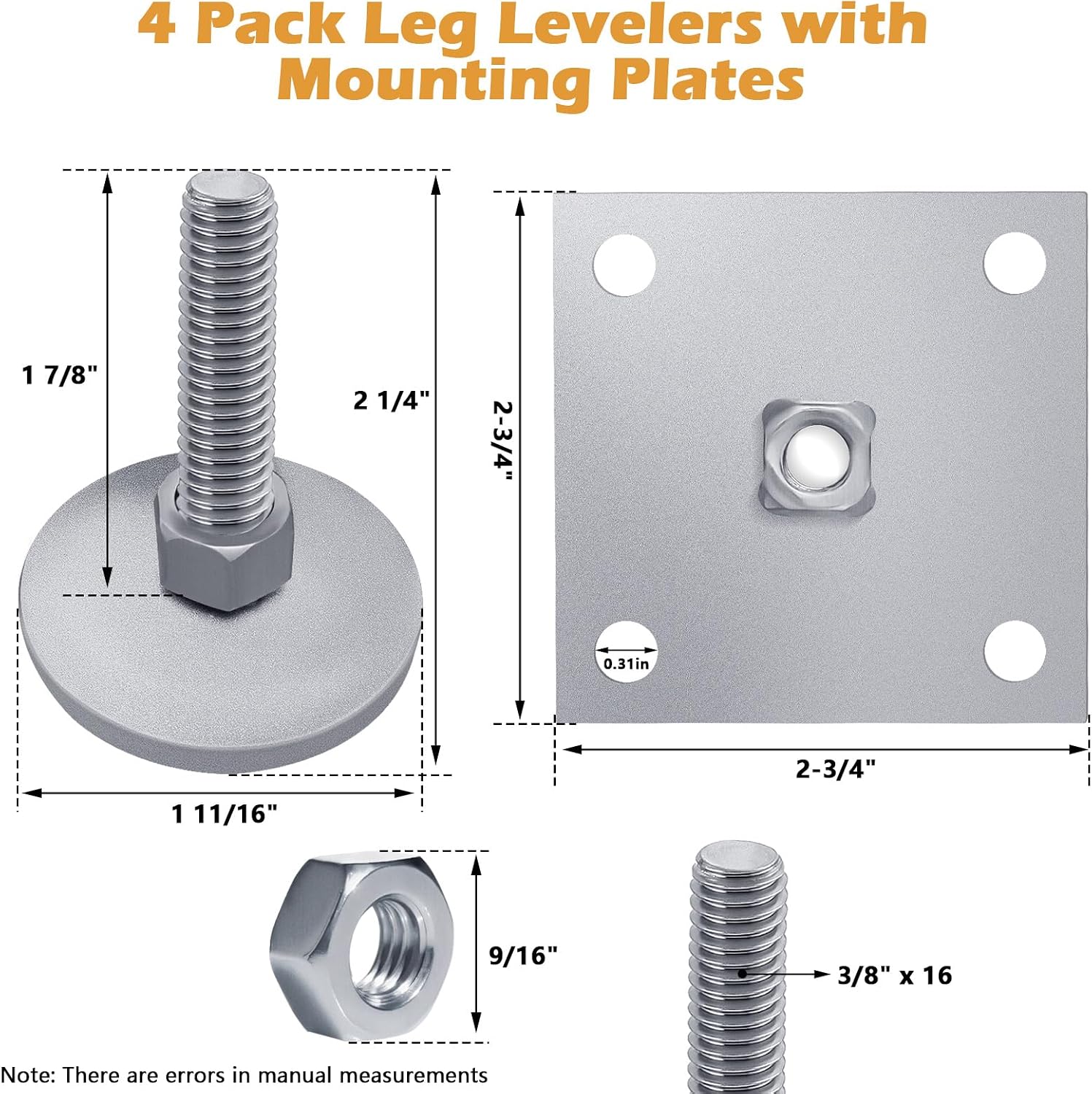
If you’ve ever watched a full-size arcade cabinet rock gently every time someone leans on the joystick, you’ve already felt the problem this article solves. Arcade cabinets — the tall, heavy gaming machines that can weigh anywhere from 150 to 400-plus pounds — sit on floors that almost never cooperate. Basement slabs develop low spots. Garage floors slope toward drains. Older home game rooms have hardwood that bows and crowns with humidity. Leg levelers (adjustable feet that thread into the bottom of a cabinet’s legs, letting you raise or lower each corner independently) and furniture risers (solid platforms placed under the entire base to add height and stability) are the two hardware solutions most builders reach for. The catch is that published weight ratings on these products are frequently optimistic — and an under-spec’d leveler under a 350-pound upright cabinet isn’t just a wobbly inconvenience. It’s a tipping risk. This guide walks through what the specs actually mean, where the real-world numbers diverge, and how to match the right hardware to your specific cabinet and floor situation.
| EDITOR'S PICK12 Pack Furniture Risers 2 or 4… | Mid-tierBigEmpty Heavy Duty 2" Leg Leve… | Budget pickBed Risers 2 inch | |
|---|---|---|---|
| Height Options | 2" or 4" | 2" | 2", 3", 4", 6", 8" |
| Capacity | — | — | 6000 lbs |
| Pack Count | 12 | 4 | 4 |
| Adjustable | ✓ | — | — |
| Material | — | Metal | — |
| Price | $29.99 | $18.88 | $17.98 |
| See on Amazon → | See on Amazon → | See on Amazon → |
Why Weight Ratings on Levelers Are Almost Always Misread
Here’s where most buyers trip up: a leveler rated for “1,000 lbs” almost never means one leveler will hold 1,000 pounds safely on its own. It means the manufacturer tested the hardware to that load in ideal, static, lab-axis conditions — meaning downward force only, on a flat surface, with no moment load (side-to-side or front-to-back stress).
The moment load problem is the critical one for arcade cabinets specifically. When a player palms a trackball hard, pounds a six-button layout, or leans into a steering wheel, they’re generating a lateral (sideways) force that translates directly to the front legs as a rocking lever. This Old House’s furniture leveling coverage consistently emphasizes that moment load on an adjusted foot — one that’s been wound down even half an inch to correct for floor slope — can be two to three times the static load because the adjustment thread itself becomes a bending point.
What this means in practice: if your cabinet weighs 280 pounds distributed across four legs (roughly 70 lbs per corner in ideal conditions), you should not be selecting levelers rated for 100 lbs each. That’s a 30% safety margin under static load alone, and it leaves you nothing for dynamic gameplay forces. The target, per mechanical hardware guidance from Popular Mechanics’ coverage of heavy furniture feet, is a minimum of a 2:1 safety factor over the per-leg static load — meaning you want levelers rated for at least 140–200 lbs per foot on a 280-lb cabinet, before you even account for floor angle correction.
Threaded Insert vs. Glide-Plate Designs
There are two main construction approaches, and they perform very differently under load:
Threaded insert levelers bolt or press into a pre-threaded hole in the cabinet’s bottom rail. The foot threads in and out, and you adjust height by rotating the foot body. These are by far the more common design on commercial-grade stands and factory-built cabinets. The failure mode is thread stripping under combined vertical and moment load — especially when the insert is pressed into MDF (medium-density fiberboard, a common cabinet material made from compressed wood fibers and resin) rather than solid wood or steel. Owners on CoinOp.org’s hardware threads consistently report that MDF-inserted levelers begin to wobble after 12–18 months of regular play, not because the foot failed, but because the MDF around the insert compresses and loses grip. The fix is either a steel backing plate epoxied above the insert cavity or upgrading to a weld-nut insert in a steel-plate base.
Glide-plate risers are a different animal — typically a rubber or neoprene pad or a cast-plastic platform that sits under the cabinet’s entire footprint rather than at individual corners. These don’t offer independent corner adjustment, but they distribute load across a much larger surface area, which makes them the more structurally conservative choice for very heavy cabinets (300 lbs and up) on concrete floors where you’re dealing with a mild overall slope rather than per-corner variation. Apartment Therapy’s furniture protection coverage notes that felt-and-rubber combination glide plates under appliance-weight objects perform significantly better long-term on hardwood because they prevent concentrated point loads from telegraphing through the finish.
The Real Numbers: Weight Capacity by Hardware Class
Before you spec anything, you need your cabinet’s actual shipping weight — not the “assembled weight” listed in the product description, which sometimes omits the monitor weight or uses a pre-monitor figure. Then add 10% for player force and lean. That’s your working load.
By the numbers:
| Hardware Class | Typical Per-Foot Rating | Realistic Per-Foot Working Load | Best For |
|---|---|---|---|
| Budget plastic levelers (Arcade1Up-style) | 75–100 lbs | 50–60 lbs | Sub-150 lb pedestal cabinets only |
| Mid-grade zinc/steel adjustable feet | 150–250 lbs | 100–175 lbs | 150–300 lb uprights, home use |
| Commercial-grade stainless threaded feet | 400–600 lbs | 300–450 lbs | 300–500 lb cabinets, venue/bar use |
| Rubber isolation risers (full-footprint) | 500–1,500 lbs (total) | Match to full cabinet weight | Heavy uprights, concrete floors |
Game Room Solutions’ product spec documentation puts their heavy-duty adjustable leveler series — the ones commonly specified under commercial cocktail and upright cabinets — at 400 lbs per foot rated capacity, which maps to a realistic working load of roughly 300 lbs per foot when accounting for a standard 1.5:1 safety derating for dynamic play use. That’s meaningful headroom for anything short of a full-size multi-game cabinet loaded with a 32-inch monitor and a secondary display.
Floor Type Changes Everything
The floor surface is at least as important as the leveler’s rated capacity, and it’s the variable most often ignored in spec comparisons.
Concrete (sealed or bare): The gold standard for heavy cabinets. Concrete doesn’t compress, deflect, or shift seasonally. Threaded steel levelers on concrete can perform close to their rated spec because the bearing surface is rigid. The main concern here is the leveler’s base pad material — bare steel feet on sealed concrete will migrate over time under vibration. Neoprene or hard rubber base pads are mandatory; they add grip and dampen the low-frequency vibration from subwoofers and button hammering that can slowly walk a cabinet across a floor.
Hardwood (nail-down or floating): More complicated. Nail-down hardwood over a wood subfloor has meaningful flex — floor joists at 16-inch centers can deflect measurably under a 350-lb point load concentrated on a 1-inch leveler foot. Popular Mechanics’ guidance on furniture foot selection for hardwood consistently recommends either a load-spreading base pad (minimum 2-inch diameter at the contact point) or full-footprint risers that distribute load across the entire cabinet base perimeter. Additionally, floating hardwood floors (the snap-together laminate style common in finished basements) should be treated with extra caution: manufacturers like Pergo and Shaw specify maximum point-load limits in their installation documentation, and a heavy arcade cabinet on a 1-inch leveler foot can exceed those limits, causing the locking joints to crack or the planks to buckle upward at the edges.
Vinyl plank (LVP): Growing in game rooms because it’s waterproof and easy to install, but it’s the most problematic surface for leg levelers. LVP is a thin, relatively soft material over a foam underlayment. Heavy point loads compress the foam layer permanently, which means your leveler adjustment will drift over 6–12 months as the underlayment slowly gives way. Owners in CoinOp.org hardware discussions specifically flag this: a cabinet that’s perfectly level at installation on LVP will need re-leveling periodically, and in severe cases the LVP will develop visible indentations that never fully recover. Full-footprint risers are strongly preferred here — they spread the load enough to stay within the LVP’s compression tolerance.
Buying Decision Framework: Matching Hardware to Your Situation
This is where practitioners can stop second-guessing. Run through this sequence before you add anything to a cart:
Step 1 — Get the actual weight. Pull the cabinet’s shipping weight from the manufacturer or your purchase documentation. If you only have “assembled weight,” add 15% to account for monitor, power supply, and play stress. That’s your working load.
Step 2 — Divide by four, then apply safety factor. Working load ÷ 4 legs × 2 (safety factor) = minimum per-foot rating you should be shopping. For a 320-lb cabinet: 320 ÷ 4 = 80 lbs per leg static, × 2 = 160 lbs minimum per-foot rating.
Step 3 — Assess your floor type. Concrete or tile: threaded steel adjustable levelers are appropriate and will hold spec. Hardwood or LVP: either use levelers with large-diameter base pads (2 inches minimum) or switch to full-footprint risers.
Step 4 — Check the insert material. If your cabinet base is MDF, add a steel backing plate over the insert cavity before relying on a threaded leveler for a 200-lb+ cabinet. If the base is solid wood or steel, standard threaded inserts are fine.
Step 5 — Plan for re-leveling. Even correct installations drift. Build in a quarterly level-check — a small torpedo level (a short, compact level tool) placed on the monitor bezel top edge takes 30 seconds and catches drift before it becomes a rocking problem.
The Commercial and Venue Operator’s Specific Concerns
If you’re specifying levelers for a bar, gaming lounge, or entertainment venue where cabinets run on a daily schedule and get significantly more aggressive play, the calculus shifts. The budget and mid-grade hardware classes essentially drop off the list. Commercial-adjacent buyers should be looking exclusively at stainless-threaded or zinc-alloy commercial-grade feet, with per-foot ratings at or above 400 lbs regardless of actual cabinet weight — because the 2:1 safety factor becomes a 3:1 target when you’re accounting for 8–12 hours of daily play, staff cleaning forces (people bumping cabinets while mopping), and the occasional patron who uses the cabinet as a leaning post.
ADA compliance (the Americans with Disabilities Act, which governs accessible design in public venues) adds a dimensional consideration: levelers that raise the cabinet’s base more than ½ inch from floor level can affect the effective reach range and approach clearance requirements for sit-down and cocktail-style units. If you’re adjusting a cocktail cabinet for a sloped floor and the leveler correction exceeds that ½-inch threshold on any side, review the reach-range tables in the ADA Standards for Accessible Design — specifically Section 308, which covers forward and side reach limits — before finalizing the installation.
The Bottom Line
Leg levelers and furniture risers are low-cost hardware that protects expensive investments, and the failure modes are entirely predictable if you run the weight math before you buy. The decision rule is simple: if your cabinet is over 200 lbs, your floor is anything other than bare concrete, or you’re in a commercial setting, don’t use budget plastic levelers — the per-foot capacity math won’t hold under real play conditions. Spend the extra $40–$80 on commercial-grade threaded steel feet with rubber base pads, verify the insert material in your cabinet base, and plan to re-check level quarterly. The wobble problem is solvable. The tipping problem, once it happens, is much harder to explain.