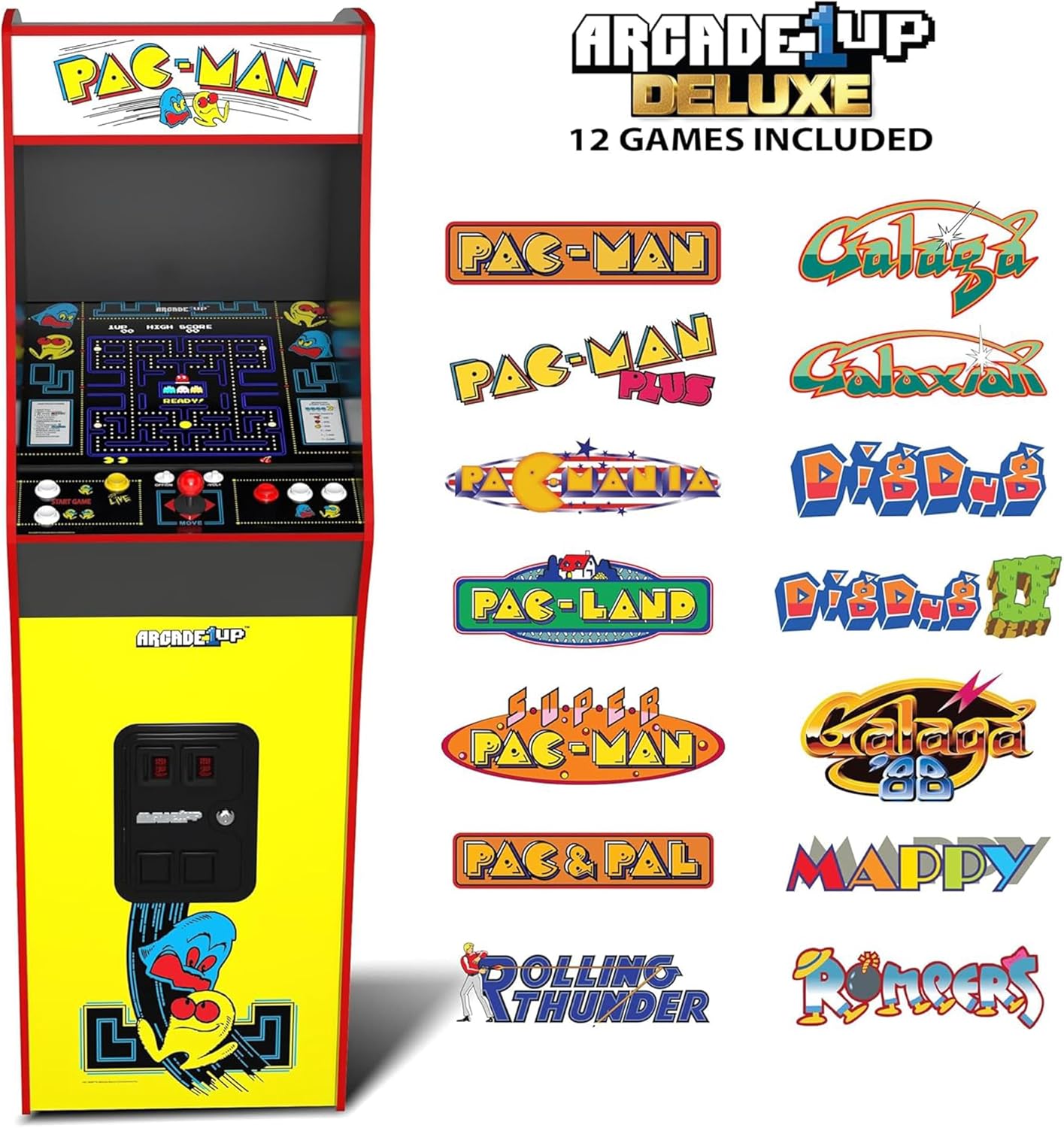
If you’ve been circling the Arcade1Up Deluxe lineup — Street Fighter II Champion Edition, Mortal Kombat, Final Fight, and their cohort — you’ve probably already noticed that the product pages list a riser and sometimes a stool as part of the bundle. What those pages don’t tell you clearly is that the Deluxe cabinet (Arcade1Up’s taller, wider format designed to more closely replicate a full-size arcade footprint) ships with different base dimensions and a higher play-surface height than Arcade1Up’s standard 3/4-scale cabinets. That distinction matters the moment you try to mix and match accessories. A riser built for a standard Arcade1Up unit can sit under a Deluxe cabinet and look fine in the box photo — and then put your control deck at the wrong height for any adult who wants to play standing up, or leave a stool at a seat height that’s either too low or awkwardly high. This guide exists to close that gap: you’ll walk away knowing exactly which riser heights work, which stool specs match, and how to evaluate a bundle before you click buy.
Why the Deluxe Format Changes Every Accessory Calculation
The core issue is a dimensional step-change that Arcade1Up doesn’t always headline in its marketing copy. Standard Arcade1Up cabinets arrive at roughly 53–54 inches tall without a riser, with a control deck sitting around 36–38 inches off the floor — noticeably shorter than the 42–44 inch control-deck height of a genuine 1980s arcade cabinet. The Deluxe series corrects for that: per Arcade1Up’s own published spec sheets for the Deluxe line, these cabinets stand approximately 66–68 inches tall without a riser and place the control surface closer to the 41–43 inch range that serious collectors find ergonomically correct for stand-up play.
That sounds like a win — and it largely is. But it creates a downstream math problem for risers and stools:
By the numbers
- Standard Arcade1Up cabinet height (no riser): ~53 in
- Deluxe cabinet height (no riser): ~66–68 in
- Standard Arcade1Up riser adds: ~12 in
- Deluxe cabinet + standard 12 in riser = ~78–80 in total — potentially above comfortable reach for players under 5’6”
A 12-inch riser, which is the accessory Arcade1Up packages with most standard cabinets and which is widely sold separately at the $49–$79 price point, can push a Deluxe cabinet into an ergonomic dead zone. Arcade Heroes’ coverage of the Deluxe series has flagged this for multiple titles: the cabinets are already near full-size, and stacking a standard riser underneath moves the control deck into the 53–55 inch range — fine for display height, awkward for play.
The practical takeaway: if you’re buying a Deluxe, the riser question is not “should I add one?” but “do I actually need one, and if so, which height?”
Riser Heights That Make Sense for Deluxe Cabinets
The riser decision for a Deluxe cabinet breaks into three legitimate use cases. Work out which one fits your setup before you touch the add-to-cart button.
Use case 1: You want the cabinet flush to the floor, no riser. This is more defensible with a Deluxe than with a standard unit. Because the Deluxe already puts the control surface at ~41–43 inches, many players 5’4” and above will find stand-up play comfortable without any riser at all. Coinop.org’s community measurement thread on Arcade1Up riser compatibility shows consistent owner reports that Deluxe cabinets at floor level feel “close enough to real arcade” for the majority of adult players. If your game room has carpet with significant pile (more than 3/4 inch), a thin leveling platform — 2–4 inches — helps more than a full riser.
Use case 2: You’re adding a riser for cable management or leveling, not for height. Some buyers add a riser under any cabinet because a hollow riser creates a natural conduit for power cords and surge protector placement. If that’s your goal, a low-profile 6-inch riser sized for the Deluxe footprint (roughly 19–21 inches wide by 20–22 inches deep, depending on the specific title) achieves cable routing without pushing the control deck out of reach. Game Room Solutions’ buyer FAQ specifically notes that riser purchases for Deluxe-series cabinets should specify the wider footprint — their Deluxe-compatible risers carry different SKUs from their standard-cabinet line precisely because the base plate dimensions don’t overlap.
Use case 3: You’re a taller player (6’0”+) who wants the original arcade feel. If you’re on the taller end and you genuinely want the 44–46 inch control deck height of the largest original cabinets, a 4–6 inch riser under a Deluxe gets you there without overshooting. The 12-inch standard riser is almost certainly too much.
The riser height decision rule, simplified:
- Under 5’4”: no riser, or a 2-inch leveling pad only
- 5’4”–5’10” (majority of adult players): no riser, or 4-inch max
- 6’0”+: 4–6 inch riser, custom or Deluxe-spec from a known supplier
- Anyone: if your only goal is cable routing, a 6-inch hollow riser works regardless of player height
Stool Selection: Seat Height Math for Deluxe Play
Stools bundled with standard Arcade1Up units typically spec at 24–26 inches of seat height, which pairs with a 36–38 inch control deck for sit-down play with some lean room. Pair that same stool with a Deluxe cabinet’s 41–43 inch control deck and you’re hunching forward — the ergonomic equivalent of using a kitchen chair at a drafting table.
For sit-down play on a Deluxe cabinet, target a stool with 29–32 inch seat height. That range gives an adult player upright posture with arms at roughly a 90-degree angle to the control surface, which is what original arcade sit-down designs were engineered around.
The stool bundles Arcade1Up sells alongside Deluxe cabinets do account for this — their officially bundled stools for the Deluxe line spec at 30 inches of seat height in published product listings, which is meaningfully different from the 24-inch stools bundled with standard cabinets. But the distinction gets lost on product pages that show the same stool photo across multiple cabinet tiers. Arcade Heroes’ Deluxe coverage called this out directly: “the bundled stool in the Deluxe package is not the same unit as the standard-cabinet stool, but you’d have to read the spec table to know it.”
If you’re buying a stool separately rather than as part of a bundle:
| Control Deck Height | Target Stool Seat Height | Fit Notes |
|---|---|---|
| 36–38 in (standard Arcade1Up) | 24–26 in | Standard bundle stools work |
| 41–43 in (Deluxe, no riser) | 29–32 in | Must verify spec; most 3rd-party “arcade stools” default to 24 in |
| 44–46 in (Deluxe + 4–6 in riser) | 32–34 in | Bar-height stools; harder to find in arcade-aesthetic finishes |
Third-party stools at the $40–$80 price tier rarely hit 30 inches of seat height — they cluster at 24–26 inches because that’s what the standard Arcade1Up market trained the accessory suppliers to produce. If you’re going third-party, measure explicitly and don’t rely on listing descriptions that say “fits Arcade1Up.”
Bundle vs. Buying Components Separately: The Tradeoff Math
Arcade1Up Deluxe cabinets currently retail in the $400–$600 range depending on title and sale timing. The bundled riser-and-stool configurations — when Arcade1Up offers them — typically add $80–$130 to that price. Buying those two accessories separately from third-party suppliers at the same spec can run $60–$160 depending on whether you need Deluxe-footprint sizing and a 30-inch stool.
The bundle wins on one dimension: fit guarantee. When you buy the riser and stool from Arcade1Up as part of the Deluxe package, the components are spec’d to that cabinet. The risk of a bolt-pattern mismatch or a seat height that fights the control deck is on Arcade1Up, not on you.
The separate-component path wins on two dimensions: finish flexibility and stool quality. Arcade1Up’s bundled stools are functional, but owners across aggregated reviews consistently describe the cushioning and swivel mechanism as “adequate” rather than “good” — fine for occasional play sessions, noticeable if you’re running extended sessions or furnishing a game room where guests will sit for hours. Third-party stools in the $80–$120 range from suppliers like Giantex or Flash Furniture (widely stocked through major retailers as of mid-2026) hit the 30-inch seat height and offer meaningfully better cushioning by owner accounts, though you’ll need to verify seat-height spec on each individual SKU rather than trusting the category label.
Decision rule:
- If fit certainty and one-box simplicity matter more than stool quality: buy the Arcade1Up Deluxe bundle with riser and stool included. You’re paying a modest premium for guaranteed compatibility.
- If you’re furnishing a dedicated game room and the stool will see regular use: buy the cabinet and riser as a bundle (or Deluxe-spec riser separately), and source a 30-inch bar-height stool independently with a budget of $80–$140. The stool upgrade is worth it over 2–3 years of use.
- If you don’t need a riser at all (5’4”–5’10” player height, no cable routing goal): skip the riser entirely, save $50–$80, and put that toward the better stool.
What to Check Before You Finalize Any Deluxe Bundle
Intermediate buyers often get tripped up not by the wrong choice but by incomplete information at checkout. Before you commit, run through this short checklist:
1. Confirm the cabinet series is actually Deluxe, not Legends or a co-branded variant. Arcade1Up’s lineup has expanded with sub-brands and licensed configurations (Legends Ultimate, co-branded Fight Stick editions) that use different footprints. “Deluxe” on the box should correspond to the ~66-inch-tall, wider-base format. If the listed cabinet height is below 60 inches, you’re looking at a standard-format cabinet regardless of what the title page says. Per Game Room Solutions’ dimension reference guide, the Deluxe footprint runs approximately 19.5–21 inches wide at the base — narrower than that and you’re in a different product family.
2. Verify the riser’s base plate dimensions match your cabinet’s footprint. This is the most common mismatch owners report. A riser with a 17-inch base plate will physically sit under a 20-inch-wide Deluxe cabinet but will look mismatched and can create instability at the base corners. Riser and cabinet base plate dimensions should be within half an inch of each other on both width and depth.
3. Check shipping method before you finalize. Arcade1Up Deluxe cabinets typically ship via LTL freight (Less Than Truckload — a pallet-based delivery method that requires a signature and sometimes a loading dock or liftgate arrangement, unlike standard parcel shipping). If you’re ordering riser and stool separately from a different supplier, those often ship parcel. Coordinating two delivery windows, one of which requires scheduling, is a friction point that’s worth knowing about before checkout, not after. Forums across the arcade community consistently rank LTL delivery surprises as the top post-purchase frustration in this category.
The bottom line on Arcade1Up Deluxe bundles is straightforward once you internalize the dimensional step-change: these cabinets are close to full-size, and they deserve accessories that treat them that way. A standard 12-inch riser and a 24-inch stool are spec’d for a different product family. Match your accessories to the Deluxe spec — 0–6 inch riser based on your height, 29–32 inch stool seat height — and you’ll have a setup that holds up both ergonomically and aesthetically for the long run.