If you’ve been pricing out pedestals for a bartop arcade cabinet — that’s the compact, countertop-style arcade unit that sits roughly 12–18 inches above whatever surface holds it up — you’ve probably noticed something: a decent purpose-built bartop stand and a mid-range AV media shelf (the kind of furniture-grade unit designed to hold televisions, receivers, and game consoles) overlap heavily in price, footprint, and visual profile. At first glance, an AV shelf with a wood-veneer or laminate finish looks like it could do the job for less money or with better aesthetics. Sometimes that’s true. Often it’s not, and the failure mode is predictable and expensive. This article breaks down exactly where bartop arcade stands and AV media shelves diverge — on finish color fidelity under real lighting, on weight capacity as rated versus what owners actually report, and on the structural differences that matter most if you’re furnishing a commercial game room or a dedicated home arcade. By the end, you’ll have a clear decision rule you can apply to the specific deal you’re evaluating right now.
Why Finish Color Is More Complicated Than It Looks
The finish question sounds cosmetic, but it’s actually a durability and resale signal dressed up as an aesthetics problem.
Bartop arcade cabinets — especially the Arcade1Up line and its licensed clones — ship predominantly in one of three surface treatments: matte black vinyl wrap, gloss black laminate, or printed side-art over an MDF (medium-density fiberboard, a dense engineered wood used widely in furniture and cabinets) shell. The first two are the ones that matter for stand matching, because the stand will be visible from cabinet-height down to floor level, often in the same eyeline as the cabinet body itself.
Purpose-built bartop pedestals from suppliers like Game Room Solutions are typically spec’d to match these treatments deliberately. According to the Game Room Solutions 2025–2026 product catalog, their standard bartop pedestal is offered in “matte black” and “gloss black” as distinct SKUs — not the same finish shot in different lighting — because the sheen level is calibrated to the most common Arcade1Up shell finishes. That specificity matters under home lighting, which is almost always warmer and more raking than the daylight-balanced photos on any product listing page.
AV media shelves from mainstream furniture manufacturers use finish designations like “espresso,” “dark walnut,” “black-brown,” or “matte charcoal” — descriptors that vary wildly between brands and even between production runs of the same model. This Old House, in its editorial coverage of wood finish designations, makes the point plainly: consumer furniture finish names are marketing language, not standardized color codes. What one brand calls “matte black” reads as a warm dark gray under incandescent lighting. What another brand calls “espresso” can photograph identically to “matte black” online but diverge sharply on a showroom or game room floor.
The practical implication: owners in aggregated threads on Coin-Op Community (coinop.org) consistently report that AV shelf finishes that looked like a match in product photography turned out noticeably warmer or cooler once placed next to their cabinets under actual game room lighting. The complaints cluster around two specific mismatches — brown undertones in “espresso” finishes against the neutral-black of Arcade1Up MDF wrap, and sheen-level divergence where the shelf reads gloss and the cabinet reads matte even when both were labeled “black.” Purpose-built bartop stands solve this by designing to a specific cabinet family. AV shelves solve it by luck or by returning the shelf.
If finish coherence is a hard requirement — and in a commercial venue or a showpiece home arcade, it typically is — the only reliable approach is to either order a purpose-built stand or request physical finish samples before committing. No product listing photo substitutes for a side-by-side comparison under your actual ambient light.
Weight Capacity: What the Ratings Say vs. What Owners Report
This is where the divergence becomes structural, not aesthetic. Understanding weight ratings requires knowing how they’re generated — and that context changes how you shop at every price tier.
Budget Tier: Where Both Options Disappoint
 product image](/images/external/a7e005ec17e6.jpg)
Besiost
$89.99
In stock on Amazon
Check price on AmazonAt the $50–$120 price point, the gap between a dedicated bartop pedestal and a mid-range AV media shelf is narrower than it appears — and not in the way that favors either option cleanly.
Budget-tier flat-pack bartop pedestals in this range frequently use laminated particleboard construction — the same grade of material found in budget AV furniture. Arcade Heroes, in their “Bartop Cabinet Build Roundup” editorial overview of common bartop dimensions and base compatibility, notes that the lowest-cost dedicated pedestals frequently use the same grade of laminated particleboard as budget AV furniture, with similar long-term joint durability. Their advertised static load figures of 80–120 lbs look adequate on paper. In practice, coinop.org owner threads show joint separation at the corner blocks within 12–18 months of regular play use.
Budget AV shelves rated in the same load range suffer the same joint vulnerability — with the added complication that they are not drilled or designed to accept arcade cabinet mounting points. First-time builders report that the DIY mounting solutions required add real friction and, in some cases, introduce stress concentrations at points the shelf was never designed to absorb.
The budget tier is the one segment where the finish problem and the weight problem are equally acute, and where neither product category has a structural advantage worth defending.
Besiost
$89.99
In stock on Amazon
Check price on AmazonMid-Tier: The Decision Point for Most Home Buyers
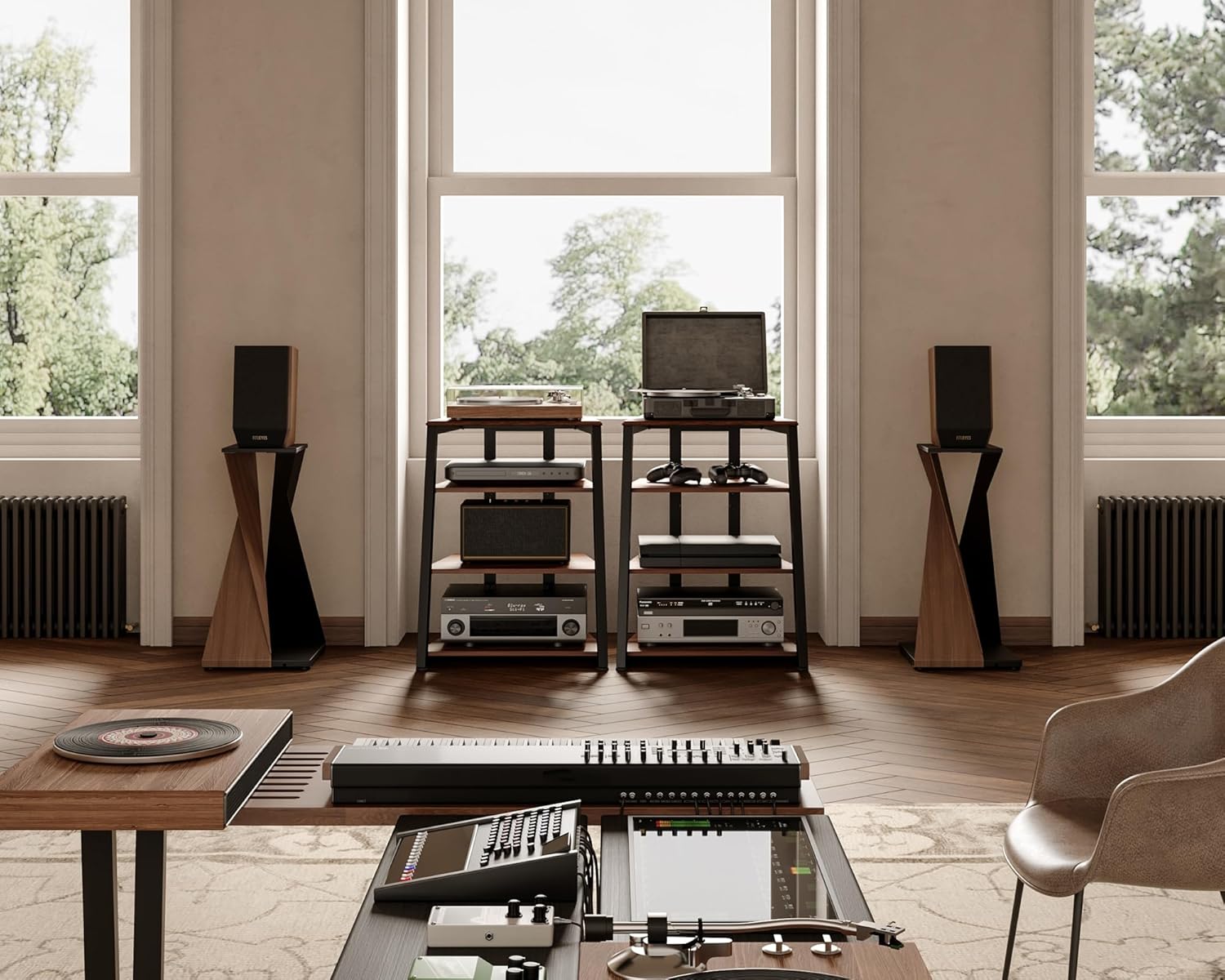
FITUEYES
$117.60
In stock on Amazon
Check price on AmazonThe $150–$350 range is where the comparison gets interesting and where most home arcade buyers are actually shopping.
Bartop arcade cabinets are heavier than they look. A standard Arcade1Up bartop unit — cabinet body only, before monitor, controls board, and power supply — runs approximately 40–65 lbs depending on the title. Add a 19-inch LCD monitor, a full control deck, and any internal modifications, and realistic all-in weight for a single bartop unit sits between 70 and 100 lbs.
Popular Mechanics, in their editorial piece “What Load Ratings on Furniture Really Mean,” makes a distinction that is directly relevant here: static load ratings on consumer furniture are typically tested under ideal laboratory conditions — weight centered, evenly distributed, on a level surface. Real-world arcade use introduces off-center loading (players lean on controls, which are offset from center), vibration from button-mashing and joystick input, and repeated repositioning stress on joints. The effective usable load under these conditions is typically 70–80% of the advertised static rating for furniture-grade shelving.
Purpose-built bartop pedestals in the mid-tier use steel-frame or reinforced MDF construction that accounts for play-input dynamics. The Game Room Solutions 2025–2026 product catalog specifies both static and dynamic load figures for their mid-tier pedestal line — with a standard steel-frame unit rated at 250 lbs static and 175 lbs dynamic, the latter figure explicitly accounting for vibration from player interaction. That engineering lineage comes directly from the arcade industry’s expectations, not furniture use.
Mid-tier AV media shelves rated at 100–150 lbs look sufficient against a 90-lb cabinet — until the 70–80% usable load rule is applied. At that point, a shelf rated at 120 lbs has an effective working ceiling of 84–96 lbs under play conditions. A bartop unit near the top of the typical weight range leaves almost no margin. Coinop.org’s aggregated owner discussion shows this pattern repeatedly: furniture-grade AV shelves that hold televisions without issue develop structural wobble and joint problems within 6–18 months under bartop units at this weight class.
The mid-tier is where purpose-built pedestal construction earns its price premium most clearly for buyers whose cabinet weighs more than 70 lbs.
FITUEYES
$117.60
In stock on Amazon
Check price on AmazonPremium Tier: Commercial and Semi-Commercial Installations
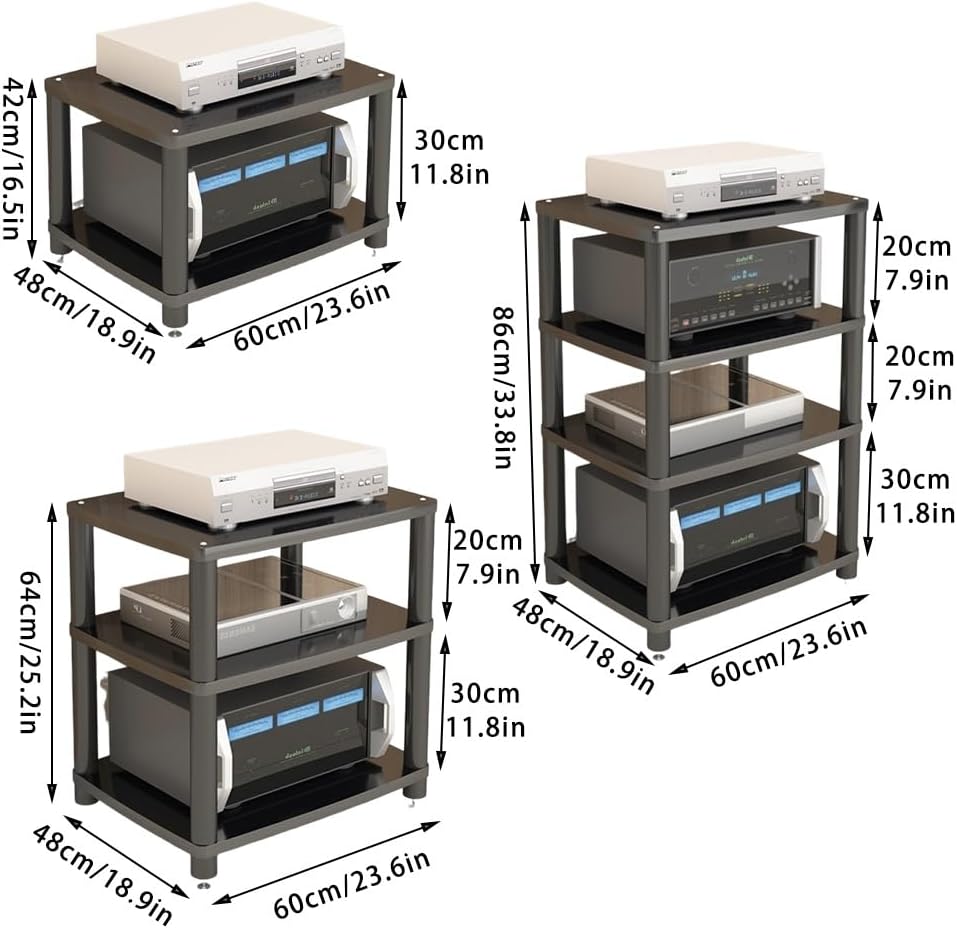
HiFi
$199.48
In stock on Amazon
Check price on AmazonAt $350 and above, the comparison is no longer between comparable product categories. Premium commercial-grade bartop pedestals — steel-frame units with welded construction, powder-coat finish, and caster systems rated for continuous floor use — are a different class of product from even the best consumer AV furniture.
If you are sourcing stands for a bar, gaming lounge, or entertainment venue, the AV shelf path fails on grounds beyond structural load. Commercial installations typically require specific footprint dimensions and height ranges related to accessibility standards — dimensions that purpose-built commercial stands are designed to accommodate and that consumer AV shelves are not. Game Room Solutions’ commercial-tier pedestal specifications document these footprint dimensions explicitly as part of their commercial product lineup.
Beyond compliance, operators running continuous floor use report that consumer furniture joints fail within 12–18 months, requiring replacement cycles that eliminate the initial cost advantage entirely. A purpose-built commercial steel-frame pedestal in the $400–$800 range is designed for this environment; a consumer AV shelf priced at $200 and replaced twice over three years is not the bargain its sticker suggests.
Note also: LTL freight — Less Than Truckload, the shipping method for large or heavy furniture that doesn’t fill a full truck — on a steel-frame commercial pedestal can run $80–$200 depending on distance and carrier. That number belongs in your total cost calculation before you compare stand prices. A $350 pedestal with $180 freight against a $480 pedestal with free freight is a different comparison than the sticker prices suggest.
HiFi
$199.48
In stock on Amazon
Check price on AmazonThe Case Where AV Shelves Actually Win
It is worth being direct: there is a legitimate use case for AV media shelves in arcade contexts, and dismissing the option wholesale would be unhelpful.
If your bartop unit is genuinely lightweight — a Raspberry Pi-based custom build in a thin MDF shell, coming in under 50 lbs — and your use case is low-intensity home play on a level surface in a climate-controlled room, a well-constructed AV media shelf can serve adequately. The finish match problem remains but is manageable if you request physical samples. The weight problem is manageable if your actual unit weight, with a margin of safety, still falls inside the 70–75% usable load window of the shelf’s rating.
This Old House’s coverage of wood finish designations is a useful reference here: when requesting finish samples from a furniture manufacturer, ask for the sheen level designation in addition to the color name. A sample labeled “matte black, 10-degree sheen” tells you something meaningful. A sample labeled “matte black” alone tells you almost nothing about how it will read next to your cabinet under warm incandescent light.
The economic argument for AV shelves is also most credible when the alternative is a budget-tier flat-pack pedestal in the $50–$120 range, where — as Arcade Heroes’ build roundup notes — construction quality differences are minimal. If you are comparing a mid-tier AV shelf against a budget pedestal, the AV shelf may genuinely be better built. The trade-off is the bolt-pattern compatibility that even a budget-grade dedicated pedestal provides: Arcade1Up-compatible pedestals are designed to accept the cabinet’s mounting points directly, where AV shelves require DIY mounting solutions that add friction for first-time builders.
How to Choose: A Clear Decision Rule
Here is the framework based on the patterns above:
If your bartop unit weighs more than 70 lbs, buy a purpose-built bartop stand. No furniture-grade AV shelf should be trusted at that load under play conditions. The structural risk is not worth the cost savings.
If you are furnishing a commercial or semi-commercial space, buy purpose-built commercial-grade pedestals. The footprint, dynamic load engineering, and long-run durability requirements all point the same direction.
If your unit is under 50 lbs and finish matching is your priority over bolt-pattern convenience, a mid-tier AV media shelf may serve you better than a budget flat-pack pedestal — provided you request physical finish samples and verify sheen level under your actual lighting before committing.
If finish coherence is a hard requirement at any weight, request a finish sample chip from your pedestal supplier before ordering. The Game Room Solutions 2025–2026 product catalog includes sheen-level designations — not just color names — that can be cross-referenced against your cabinet’s surface treatment. Those designations are the reference points that eliminate guesswork, and eliminating guesswork eliminates the return shipping cost that coinop.org threads consistently identify as the most common preventable expense in the stand-buying process.
Get the freight quote before the purchase decision, not after. The difference between sticker price and landed cost is where most stand-buying budgets go wrong.