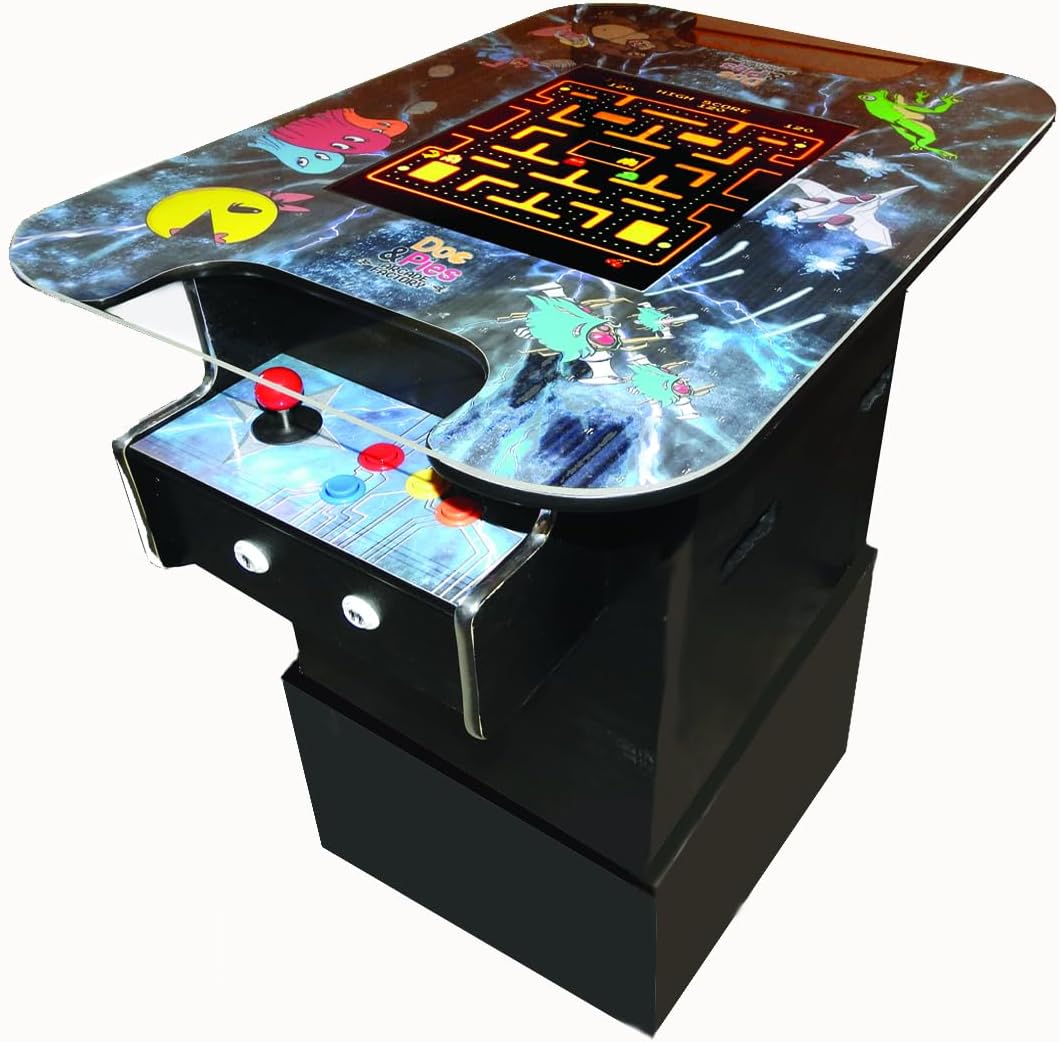
A cocktail arcade machine is exactly what it sounds like: a coin-op (or home-play) video game cabinet styled like a low cocktail table, with the monitor laid flat under a glass top so two players sit across from each other and look down at the screen. Unlike upright cabinets — the tall, stand-in-front boxes most people picture when they think “arcade game” — cocktail cabinets are designed for seated play at table height. That distinction is everything when it comes to comfort, because “table height” is not a fixed number, and the height that ships from the factory is almost never the height that works for your chairs, your bar stools, or your game room’s specific setup. This guide walks through how to calculate the right riser height for your situation, what riser products are built for this application, and — critically — how to do it without triggering language in your manufacturer’s warranty that you’d rather not trigger.
If you’re currently negotiating a purchase, mid-build on a game room install, or trying to spec a riser for a bar or lounge setup where the machines need to work for guests of different heights across a full operating day, this is the decision framework you need before you buy anything.
Why Factory Height Is Almost Always Wrong for Your Space
Most cocktail arcade cabinets ship at a playing surface height between 27 and 30 inches. That range was standardized during the original arcade era of the late 1970s and early 1980s, when cocktail cabinets were meant to double as actual bar tables — short enough that a seated patron on a standard 17–18 inch chair seat wouldn’t feel like they were hunching over a desk.
The problem is that modern seating has changed. Standard dining chair seat heights today run 17–19 inches, but gaming chairs — the category most home collectors are pairing with cocktail machines — typically sit between 18 and 22 inches with adjustability. Bar stools used in commercial venues often run 28–30 inches. If your machine’s playing surface is at 28 inches and your bar stools put your patrons’ elbows at 36 inches, the math doesn’t work: players will be reaching down uncomfortably, and sessions longer than 30 minutes will produce the kind of neck and shoulder fatigue that generates negative reviews.
Per Popular Mechanics’ coverage of ergonomic seated gaming setups, the general ergonomic target for tabletop play is a surface height that sits roughly 8–10 inches below the seated elbow height. That means a player whose elbows are at 36 inches when seated needs a playing surface between 26 and 28 inches — which a standard cocktail cabinet hits. But the same player on a 30-inch bar stool has elbows at roughly 40–42 inches, which pushes the ideal surface height to 30–32 inches. A 3–4 inch riser closes that gap.
The real-world variance is wider than most buyers expect. Arcade Heroes’ coverage of the cocktail cabinet resurgence notes that operators sourcing machines for bar and lounge environments almost universally require risers or specify custom leg heights, because the “standard” dimension was designed for a chair configuration that doesn’t exist in most modern hospitality environments.
The Riser Math: A Quick Reference
Before you shop risers, run these numbers for your specific install:
By the numbers:
| Seating type | Typical seat height | Elbow height (seated) | Ideal play surface | Riser needed over 28” cabinet |
|---|---|---|---|---|
| Standard dining chair | 17–19 in | 27–30 in | 19–22 in | None / -6 in (shim down) |
| Gaming chair (mid-range) | 18–22 in | 28–33 in | 20–25 in | None to +2 in |
| Counter stool | 24–26 in | 34–37 in | 26–29 in | 0 to +1 in |
| Bar stool | 28–30 in | 38–42 in | 30–34 in | +2 to +6 in |
The formula: Ideal surface height = seated elbow height − 9 inches (center of the ergonomic range). Riser needed = Ideal surface height − your cabinet’s playing surface height.
Measure your cabinet at the glass surface, not the frame bottom, and account for the glass thickness if you’re placing anything on top.
Riser Types and What the Spec Sheets Actually Say
Risers for cocktail cabinets fall into three practical categories, and each carries different implications for your warranty exposure.
Integrated leg extensions (purpose-built for the cabinet model): A handful of manufacturers — including some Arcade1Up cocktail models and several import suppliers serving the commercial market — sell factory risers or extended leg kits designed specifically for their cabinet. These are the only riser configurations that are generally neutral to warranty language. The Game Room Solutions 2025 catalog, for example, lists riser kits for compatible cocktail units rated to the same weight capacity as the base cabinet legs, and documentation explicitly states they’re covered under the same limited warranty period. If your manufacturer sells a first-party riser, this is always the cleanest path.
Universal flat-pack pedestal risers: These are the $50–$120 range products most home builders encounter first. Typically MDF or particle board with a laminate finish, they’re designed as a platform the entire cabinet sits on rather than a leg extension. The key spec to check: weight capacity. A standard cocktail cabinet weighs 90–160 lbs depending on monitor size and construction; a pedestal rated for 150 lbs sounds like it clears that — until you factor in players leaning on the glass during a session. Owners in the coinop.org community threads consistently flag that leaning load can spike the effective downward force by 30–50 lbs in short bursts, which means a cabinet that weighs 130 lbs can momentarily impose 170–180 lbs on the riser’s surface. Size your riser capacity with at least a 30% overhead buffer.
Custom fabricated risers (steel, hardwood, or powder-coated steel): Suppliers like Game Room Guys and Reclaimed Arcade build custom-height risers in the $300–$800 range, with exact height specification, finish matching, and in some cases integrated cable management and leveling feet. For commercial operators — bars, gaming lounges, entertainment venues — this is the tier that makes sense economically. A riser that matches your cabinet’s finish and is spec’d for 24/7 use pays for itself in eliminated callbacks and replacement costs.
The warranty exposure question: Most cocktail cabinet warranties from consumer-facing brands include language voiding coverage for damage caused by “improper use, modification, or third-party accessories.” The gray zone is whether placing a cabinet on a third-party riser constitutes “modification.” The short answer, based on forum analysis at coinop.org and outreach summaries shared in collector communities, is: manufacturers rarely honor warranty claims where the cabinet fell or was damaged while on an unauthorized riser, but they typically still cover internal electronic failures that are clearly unrelated to placement. Document your setup. If a screen dies at month eight, the riser on which the cabinet sits is almost certainly irrelevant to the claim. If the cabinet tips, the riser geometry will be the first question they ask.
ADA Compliance and Commercial Install Requirements
If you’re speccing for a bar, lounge, or any public-facing venue, the height question isn’t just ergonomic — it has regulatory dimensions. The ADA National Network’s accessibility checklist for amusement and game machines specifies that forward reach ranges for accessible configurations must fall within 15–48 inches from the floor for a forward approach, and 9–54 inches for a side approach. Cocktail cabinets are an interesting case because the reach plane is horizontal, not vertical — but the playing surface height still determines whether a guest using a wheelchair can reach the controls and see the screen without an awkward angle.
For commercial operators, the practical guidance is: a cocktail cabinet at 28–30 inches playing surface height generally meets forward-reach requirements for a wheelchair user approaching from the front, but verify against your jurisdiction’s adopted ADA standard edition and consult your venue’s ADA coordinator before finalizing any install that will serve the public. Raising the cabinet with a riser increases the surface height and could push it outside compliant reach range for seated wheelchair users, depending on starting height. This is a real tradeoff that operators in the $600–$1,200+ per-unit bracket should explicitly spec for before ordering custom risers.
Making the Decision: If X, Then Y
Here’s the decision framework, stated plainly:
If you’re a home collector pairing a cocktail cabinet with standard dining chairs (seat height under 20 inches): Your factory height is probably correct. A riser may actually hurt ergonomics. Spend your budget on leveling feet instead of a riser.
If you’re a home builder pairing with gaming chairs or counter stools: A 2–3 inch riser typically closes the gap. A universal flat-pack pedestal in the $60–$100 range is adequate if it’s rated for 200+ lbs and you secure the cabinet to it (most include a top mounting flange — use it). Warranty risk is low if the cabinet’s electronics are the concern; mechanical damage from poor riser choice is an owner risk you’re accepting.
If you’re outfitting a bar or lounge with bar-stool seating: A 4–6 inch riser is the likely target height. Custom fabrication is worth the cost at this scale — a $500 custom steel riser on a $1,000 commercial cabinet is a 50% upcharge that buys you finish-matched aesthetics, documented weight ratings, and a supplier you can call when something needs adjustment. Per Game Informer’s coverage of the arcade revival, commercial operators who report the best long-term satisfaction with cocktail installs almost universally cite “getting the height spec right before delivery” as a top factor.
If ADA compliance matters to your install: Do not raise the playing surface above 34 inches without explicit accessibility review. The ergonomic and regulatory goals are in tension here, and the regulatory requirement is non-negotiable. If your bar-stool setup demands a 34-inch playing surface and you also need an accessible machine, run two cabinets at different heights — one at standard and one at ADA-compliant height — rather than compromising both audiences with a single bad compromise.
If your manufacturer sells a first-party riser kit: Buy it. The warranty protection alone is worth the likely $40–$80 premium over a third-party alternative.
The riser decision looks like a hardware afterthought until your guests are slouching over a machine that sits four inches too low or craning down at one that’s four inches too high. Get the number right before the machine ships — adjusting after delivery almost always means either eating the freight cost on a second shipment or living with the wrong height for the life of the install.