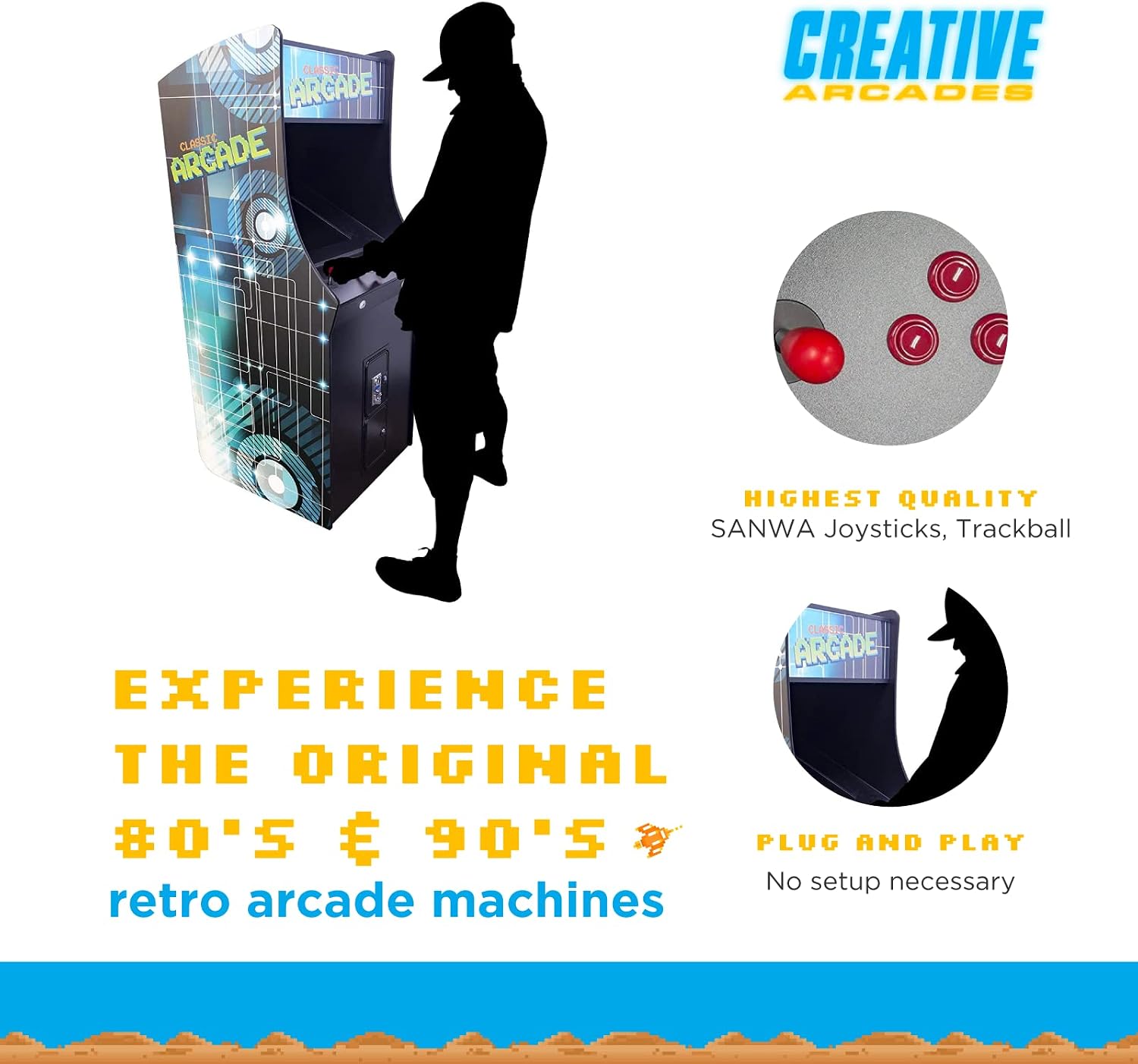
If you’ve ever ordered a large piece of furniture online and been surprised by a freight bill that arrived separately from the purchase confirmation, you already understand the first big lesson of buying commercial arcade equipment. An upright arcade machine — the tall, freestanding cabinet style you’ve seen in arcades and bars since the 1980s — is not shipped like a flat-pack bookcase. These units typically weigh between 150 and 350 pounds (68–159 kg), they ship on pallets via a freight carrier rather than a parcel carrier like UPS or FedEx, and they arrive at your loading dock (or your front curb) in a condition that depends heavily on how well the manufacturer packed and braced them. For a venue operator — a bar owner, a gaming lounge manager, a family entertainment center buyer — getting this purchase wrong means a damaged unit, a surprise $400 freight bill, or a cabinet finish that looks great in a warehouse photo but reads as mismatched gray under your venue’s LED lighting. This article walks through the three variables that matter most at the commercial tier: weight and structural ratings, LTL freight mechanics, and finish durability. By the end, you’ll have a clear decision framework for evaluating any supplier quote.
| EDITOR'S PICK[Top Us Video Arcades 4 Player G…](https://www.amazon.com/dp/B0B99ZZBBH?tag=greenflower20-20) | Mid-tier[Creative Arcades Full Size Stan…](https://www.amazon.com/dp/B07W15ZLDM?tag=greenflower20-20) | Budget pick[Unico Arcade Console Nova Blast…](https://www.amazon.com/dp/B0GFCF4DWY?tag=greenflower20-20) | |
|---|---|---|---|
| Player Count | 4 Player | 2 Player | — |
| Game Count | 4600 | 60 | — |
| Screen Size | 32" | 22" | 26" |
| Screen Type | — | LCD | 4:3 Monitor |
| Light Guns | ✓ | ✗ | ✗ |
| Warranty | — | 3 Year | — |
| Price | $3,199.00 | $2,558.34 | $1,499.00 |
| See on Amazon → | See on Amazon → | See on Amazon → |
Weight, Load Ratings, and Why the Spec Sheet Is Only Half the Story
Commercial upright cabinets are rated for what the manufacturer calls “continuous-use” or “24/7 operation” — meaning the electronics, monitor, and structural frame are engineered to run without a daily shutdown cycle. That distinction matters because residential-grade or prosumer-grade machines (the Arcade1Up segment and its immediate step-up competitors) are not designed for that duty cycle. The plastics, the PCB cooling, and the joystick mounting hardware degrade faster under all-day, all-week use.
But weight ratings and load specs on commercial equipment deserve scrutiny. Published specs from suppliers often reflect the cabinet’s empty shipping weight rather than the fully loaded operating weight (monitor, CPU board, coin door assembly, marquee lighting). According to the reference threads archived at Coinop.org’s Commercial Arcade Cabinet Weight and Shipping Reference, operators consistently report that real-world operating weights run 15–25% higher than the listed shipping weight once all internal components are installed at the factory. A unit listed at 200 lbs shipping weight may sit closer to 230–245 lbs on your floor. That difference matters for two reasons:
1. Floor load capacity. Most commercial flooring — tile over concrete slab — handles this without issue. But if you’re placing units on a raised wood subfloor (common in older bar spaces), you need to verify your floor’s point-load rating, not just its distributed load rating. A 245-lb cabinet on four small casters concentrates weight very differently than the same weight spread across a wide base. Your building contractor or the venue’s original structural drawings are the right source for this number; don’t rely on the arcade supplier to tell you your floor is fine.
2. LTL freight class. Freight carriers classify shipments using a system called NMFC freight class, which is calculated from weight, density, and handling difficulty. Heavier, oddly shaped items (like a tall arcade cabinet) land in higher freight classes, which directly drives up the per-hundredweight rate you’re charged. More on this in the next section.
One spec to actively verify with any supplier: the cabinet’s base footprint dimensions and whether the base is ADA-compliant for your jurisdiction. The Americans with Disabilities Act (ADA) doesn’t regulate arcade machines directly, but venue operators in states with stricter accessibility enforcement have reported that gaming areas need clear floor space around interactive equipment. The Arcade Heroes buying overview for business operators notes that standard commercial uprights run roughly 24–28 inches wide and 30–36 inches deep at the base, with total heights between 66 and 76 inches. If your venue layout is tight, verify the exact footprint in inches — not the “standard cabinet” shorthand — before ordering.
LTL Freight: The Cost That Breaks Budgets and How to Price It Correctly
LTL stands for “less-than-truckload.” It means your shipment shares trailer space with other shippers’ cargo, which keeps per-unit freight costs lower than chartering a full truck — but it introduces a set of variables that catch first-time commercial buyers off guard. Popular Mechanics’ overview of how LTL freight works describes the core issue clearly: LTL rates are quoted based on origin/destination ZIP codes, freight class, declared weight, and whether accessorial services (liftgate, inside delivery, appointment scheduling) are added. Every one of those accessorial services costs extra, and none of them is included in the base rate a supplier quotes you at checkout.
Here’s what “accessorial charges” looks like in practice for a venue order:
By the numbers:
- Liftgate service (carrier lowers pallet from truck bed to ground): $75–$150 per delivery, per carrier, as of mid-2026 rate schedules
- Inside delivery (carrier moves pallet past the threshold): $100–$250 depending on distance and stairs
- Delivery appointment (you schedule a window instead of taking next-available): $50–$100
- Residential surcharge (if your venue isn’t classified as commercial by the carrier’s database): $75–$175
A supplier quote showing “$0 shipping” or “free freight” on a 250-lb arcade cabinet almost certainly means the base freight is baked into the unit price and the accessorials are your problem at delivery. Ask the supplier directly: “What freight class is this unit filed under, and does your free shipping quote include liftgate service to my address?” If they can’t answer the freight class question, that’s a signal they’re using a third-party LTL broker and may not know — which also means you’re exposed to re-rating surprises (when the carrier’s dock re-weighs or re-measures the shipment and adjusts the class upward).
Game Room Solutions’ commercial buyer’s guide recommends getting at minimum two freight quotes from the supplier’s carrier and one independent quote from a freight broker using the exact dimensions and weight of the unit as shipped (including pallet and crating). The spread between these quotes is your negotiating data.
One more LTL variable operators miss: transit time. LTL freight for heavy commercial arcade equipment typically runs 5–12 business days coast-to-coast, and the carrier will attempt delivery once. If no one is available to receive and sign, redelivery fees apply. For a bar or lounge with limited daytime staffing, this is a real scheduling problem. Build the delivery appointment fee into your budget and schedule a specific window.
Finish Durability: What “Commercial-Grade” Actually Means at the Surface Level
The finish on a commercial arcade cabinet takes abuse that home units never see: sticky hands, spilled drinks, cleaning products, and the occasional impact from barstools or foot traffic. The three finish types you’ll encounter at the commercial tier each have real tradeoffs.
Laminate wrap (vinyl/foil over MDF or plywood core): The most common finish on mid-tier commercial units in the $800–$1,400 range. It’s easy to produce in high-gloss or matte variants, accepts printed graphics cleanly, and is fast to repair — a new section of wrap can be applied over damage without refinishing the whole cabinet. The weakness is edge vulnerability: repeated impact on corners lifts the wrap from the substrate, and once moisture gets under the edge, the delamination spreads. Operators in long-run reviews on Coinop.org’s commercial threads consistently note that wrap edges are the first failure point, usually within 18–30 months of bar-environment use.
Powder coat (electrostatic paint baked onto a steel frame or steel skin panels): Standard on heavy-duty commercial units from specialty fabricators in the $1,200–$2,500+ range. Powder coat is significantly more impact-resistant than laminate and handles cleaning chemicals without discoloration. The tradeoff is repair: a chip or gouge in powder coat requires professional touch-up to match the original color, because the cured finish can’t be re-applied in sections the way vinyl wrap can. Operators who prioritize longevity over repairability — typically venues that replace units every 5–7 years rather than patching continuously — consistently prefer powder coat.
High-pressure laminate (HPL, like Formica or Wilsonart applied as rigid panels): Less common on full-production uprights, more common on custom fabrications from shops like Reclaimed Arcade and Game Room Guys. HPL is hard, impact-resistant, and available in a wide color and texture range. Its weakness is that it requires a skilled fabricator to apply without visible seams at corners, and the material itself adds weight to the cabinet.
The finish consistency problem that operators most often report — and that our site’s sourcing coverage consistently flags — is the gap between how a finish photographs in a supplier’s catalog and how it reads under a venue’s actual lighting. Warm incandescent lighting makes “black gloss” look amber-tinged; cool LED lighting can make “warm walnut” laminate look greenish-gray. If you’re ordering more than two units and finish matching between cabinets matters for your venue aesthetic, request a physical finish sample chip or panel from the supplier before committing. Any reputable commercial supplier will send one. If they won’t, treat that as a yellow flag.
The Decision Framework: If X, Then Y
Here’s where to land based on your specific situation.
If your venue is ordering 1–3 units, budget is $800–$1,400 per unit, and you have a concrete-slab floor with a loading dock: Mid-tier commercial units with laminate wrap are defensible — get the freight quote with liftgate, verify the freight class, and ask about the edge-banding construction on the wrap corners specifically. Inspect the delivery on arrival before signing the carrier’s delivery receipt.
If you’re equipping a dedicated gaming lounge or bar room with 4+ units where finish consistency is part of your brand: Move up to powder-coat steel or HPL custom units from a fabricator. Request physical finish samples. Budget $1,200–$2,000+ per unit and factor LTL freight as a line item, not a surprise. Negotiate a multi-unit discount on freight by palletizing multiple cabinets together — ask the supplier if they can ship a 4-unit order on two pallets instead of four; the savings on freight class re-rating can be substantial.
If your venue has a raised wood subfloor or unconventional floor load situation: Get the structural question answered before you finalize any unit selection. The arcade supplier cannot answer this for you; your building contractor or a structural engineer can. Don’t skip this step — a 250-lb cabinet on an undersized joist span is a real liability.
If finish durability over a 5-year horizon is the primary concern: Powder coat from a fabricator who will quote a specific RAL or Pantone color match. Laminate wrap in a high-traffic commercial environment rarely makes it five years without visible edge degradation; powder coat on a properly welded steel frame regularly does.
The math on commercial arcade equipment rewards specificity. Get the exact shipping weight, the freight class, the accessorial list, and a finish sample before your order is placed. Every one of those items is negotiable or verifiable before you commit — and every one of them is harder to address after the pallet hits your loading dock.